
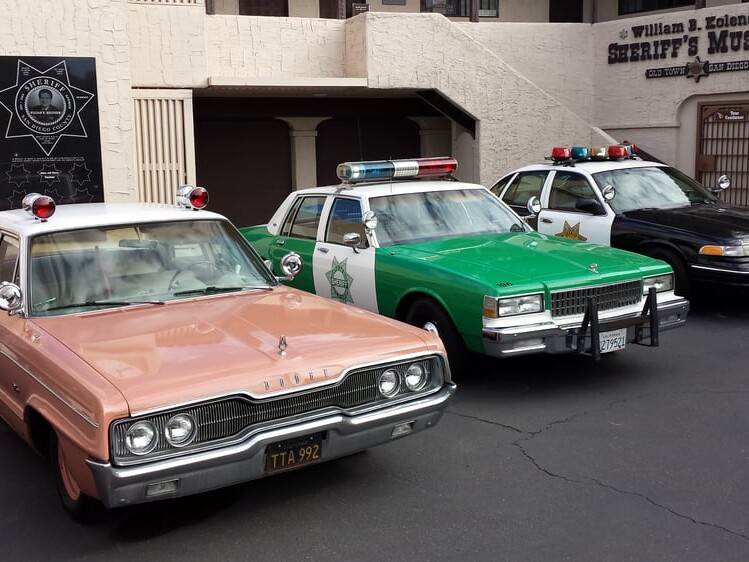
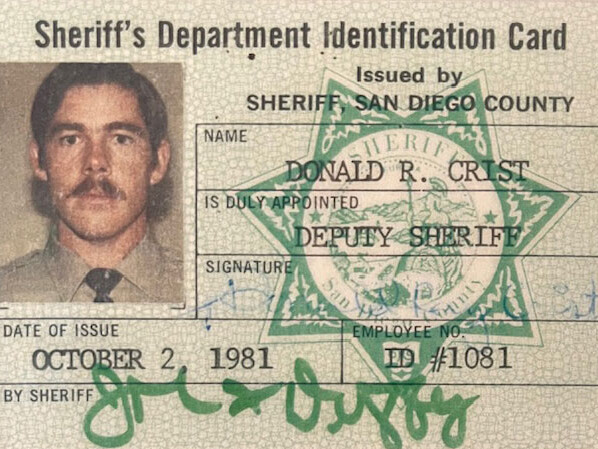
John F. Duffy became San Diego County Sheriff on January 4, 1971 and retired on January 4, 1991. He was of Irish descent so he chose a department-wide Kelly green color scheme that was soon known throughout the department as “Duffy green”. The patrol cars, buses, helicopters, and various equipment, were painted “Duffy green”. Brochures, identification cards, plastic kiddy badges, and anything produced by the department that contained a color scheme other than black and white, was generally displayed in “Duffy Green”. Sheriff Duffy even signed official documents and the department identification cards in “Duffy Green” ink. There was a saying about transfer orders within the department. The transfer wasn’t official unless “the green ink was dry”, meaning that no matter the rumor about a transfer, it wasn’t happening unless Sheriff Duffy signed the transfer order himself in green ink. So, for twenty years, the San Diego Sheriff’s patrol cars were “Duffy green” and had “Duffy green” Sheriff’s star decals on their doors That all changed when Jim Roache was elected Sheriff and took office in 1991.
In January 1991, I was visiting Sheriff’s headquarters while assigned as a traffic sergeant at the Sheriff’s Santee Station traffic unit. I happened to be standing in Commander Klippert’s office whose second-floor office overlooked the front of the building. Jim Roache (I won’t use the title “Sheriff” along with his name) was holding a press conference in front of the building and rambled on about being the new sheriff with a new attitude now that he had been elected. Roache announced that the colors of the Sheriff’s patrol cars were going to be black and white under his reign. Just as Roache finished his speech at a portable podium, a newly painted black and white patrol car pulled up and stopped in front of the reporters gathered in front. Roache walked over to the patrol car and sat in the driver seat as the TV, print, and radio news reporters huddled around him. Roache told the reporters that his objective of being elected sheriff was to effect “positive and objective change” and the new colors of the patrol cars was one symbol of that change.
As I looked down at the patrol car, there on the driver’s door was a friggin gold-colored Sheriff’s star. The star decal’s points were very elongated (so elongated that they made the star look weird). The gold miner in the state seal looked like he was digging a grave with a casket lying on the ground beside him. It was supposed to be a gold rocker box. The number of stars in the sky across the top were inaccurate. One of the ships in Sacramento River appeared to be sinking. It was difficult to tell that the vegetation at the bottom of the state seal were grape vines and a sheaf of wheat. It was a horrible cut and paste Windows Printshop version of the state seal that was duplicated by the decal manufacturer who copied it exactly. But worst of all, the Sheriff’s star was gold-colored.
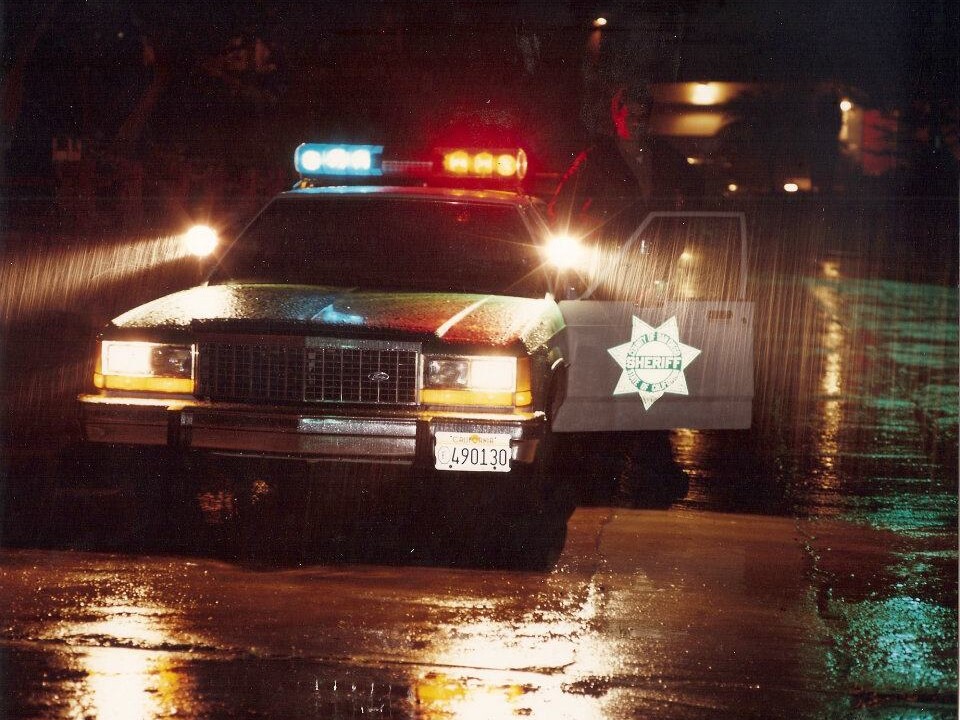
Okay, I get it. Roache won the election so he can make the cars, buses, helicopters, and identification cards any color he wants, but he replaced Duffy’s green and white Sheriff’s star decal with the same color star as the badges worn by the California Highway Patrol, San Diego District Attorney Investigators, and San Diego County Animal Control – GOLD! I was pissed. I looked down at the silver star on my uniform. I knew the Sheriff’s star had been mostly silver since 1850, and it had been silver since at least 1931. A look at the surviving badges after 1850 showed that all but one or two times, the San Diego Sheriff and San Diego deputy sheriff badges were silver-colored. I was very proud of that silver star. Apparently, the transportation lieutenant couldn’t find a real San Diego Sheriff’s badge when she produced a new star decal for Roache’s new black and white vehicles. Otherwise, how could she look at one of our silver badges, but then make the star decal gold. (One of the gold-colored star decals hangs on the wall of the Courts Assistant Sheriff front office. It’s color and graphics are embarrassing.)
(As a back story) Roache knew the dozen personnel in the Public Affairs Division, both sworn and non-sworn, were all Jack Drown supporters when Roache was running against Drown for Sheriff (except for one sworn person who surreptitiously supported Roache). After Roache came into office as Sheriff in 1991, he decimated the Public Affairs Division. He transferred everyone except for the one (pro-Roache) sergeant and the department photographer (a professional staffer). He transferred the lieutenant, one of the two sergeants, all the deputies, and all the professional staff (except the department photographer). The special assistant assigned to the public affairs division was an at will employee, so that person was replaced by a handpicked Roache supporter (as is the Sheriff’s prerogative). Aside from the special assistant, department photographer, that left the one sergeant who was the news media relations sergeant – now a one-person position. When that sergeant was later promoted to lieutenant in the spring of 1994, I tried out for the News Media Relations sergeant position. Charlie Campe got the position, but only stayed six months. In late November of 1994, personnel called me to tell me I was replacing Charlie Campe as the News Media Relations sergeant since I came in second in the interview process. It was a surreal environment. The Roache administration was a ghost town because Roache had lost the June 1994 primary to Sheriff Kolender five months prior. All the Roache command staff and appointed staff almost never came into to work after the primary in June. I pretty much winged everything I told the news organizations because no one was ever around to ask what the department wanted me to say. Besides, the Roache people didn’t care.
Forward a few months to January 1995 when Sheriff Kolender was elected sheriff and chose Jack Drown as his undersheriff. On his first day as undersheriff, I told Undersheriff Drown that I understood that they would want their own choice in certain positions like internal affairs, criminal intelligence, and the News Media Relations sergeant position I held. The undersheriff told me to stand by and they would let me know. They kept me in that position for almost three years until I transferred to homicide. In the meantime, in my position as the News Media Relations sergeant, I secretly worked with the county’s cartographics people to design a graphics file of a silver star decal with blue lettering just like our badges (what a concept) and with an accurate state seal in the middle. I also had the cartographics people provide examples of a serif-style font for the word “Sheriff” for our cars, building doors, equipment, etc. I chose a slightly old-fashioned western look that was still very readable. Since I was a one-man operation and in charge of my own budget, I could pay for county cartographic work through a work order out of my budget without anyone else knowing, including my bosses – Sheriff Kolender and Undersheriff Drown. It took several months of research and several attempts by the cartographics people to accurately depict the California State Seal the way I wanted it.
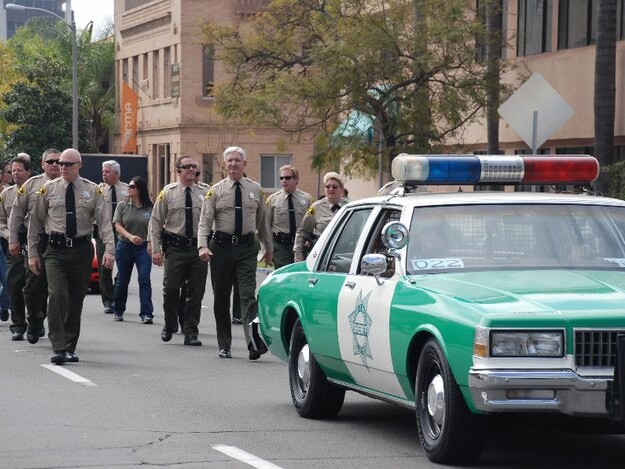
The same was true when it came to producing the actual star decals. I contacted Road America, the decal company in Ontario, California. Road America had been producing our vehicle and equipment decals for decades – first the salmon-colored star, then the green and white Duffy star, then the gold Roache star decals. The company said it was going to cost a fortune because they had to design and produce entirely new decal cutters and dies for the new star, state seal, and new lettering around the state seal. Drown and Sheriff Kolender were great to work for, but I wanted to keep my proposed silver-colored car decals a secret. I made several unauthorized trips to Ontario, California, during work hours in my county car to meet with Road America’s graphics designer. I always prayed that I would not be involved in an accident because I was out of county without permission and thus, in violation of department policy and procedures. To help keep the secret, I convinced the president of Road America not to bill the Sheriff’s Department for the new decal printing equipment, nor the typical 50% now, 50% upon production of the decals, until the first decals were produced.
In early summer of 1997, Road America called and said, “Come watch the first silver star come off of the assembly line tomorrow.” I drove up there the next day. The owner gave me a set of the new decals “hot off the press” to mock up a patrol car. He also gave me a third silver star decal and said it was mine to do with as I pleased. That third star later hung in the Sheriff’s Museum for years. I came back into San Diego and went straight to the transportation sergeant at the vehicle coordinator’s office. I said I needed to borrow a new patrol car without decals “for a public affairs project”. Since I worked directly for the Sheriff, there were no questions and I was given a new, clean car.
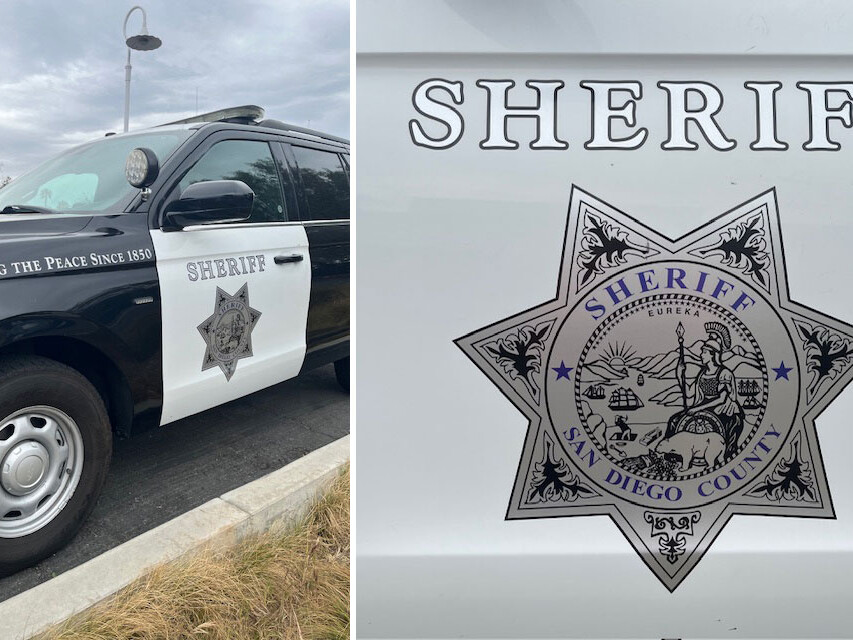
I drove the new patrol car to a secluded part of county operations and applied the new silver-colored star decals, with blue lettering, on each of the doors. I also placed the silver-colored “Sheriff” decal on the trunk. I then drove the patrol car to the front of Duffy Center, where I parked it directly in front of the entrance and went upstairs to Undersheriff Drown’s office. I asked him if he and Sheriff Kolender had a few minutes to come downstairs and look at something. They both followed me into the elevator to the first floor, then out front where the patrol car with the new decals was parked. When they saw the car I said, “This is the way our cars and equipment should look – with a SILVER Sheriff’s star that looks like our badges.” I held my breath and wondered if I was going to be walking a foot beat in the Anza-Borrego desert in August. Undersheriff Drown said he liked it and looked at Sheriff Kolender who nodded his approval and smiled. Undersheriff Drown mentioned that he once saw the phrase “Keeping the Peace Since 1850” at some Sheriff’s office somewhere in Northern California. He said he liked the phrase and that it should be placed on the cars as our motto. He asked me to put that motto on the front left and front right fenders. The rest, as they say, is now part of our (at that time) 171-year history.
During the late 90s we paid a consultant a lot of wasted money to address CSQIP issues (a long story for another time). One of the results of CSQIP was what was called the Group of 70, a group of department personnel from all levels that met regularly to help guide the department on numerous issues. After Sheriff Kolender approved the new star and motto, I presented the new star design to the group and gave computerized files to anyone who was involved in producing a Sheriff’s badge image within their divisions. An assistant sheriff asked me to produce a Sheriff’s silver star image with a multi-colored state seal in the middle. I told him I was against the idea since our badges didn’t have multi-colored state seals in them. Contrary to the entire purpose of CSQIP and the Group of 70, that one person decided he wanted a silver star image with a multi-colored state seal in the middle. Since he was an assistant sheriff and I was just a sergeant, I worked with the county cartographics people to produce a seal with a multi-colored state seal. In my opinion, all the stars with the multi-colored state seal should be destroyed. I’m proud of our all-silver star with the blue lettering.